
By Sunny Orleans
Failte Go An Daingean! (Welcome to Dingle)
I do not live in diaspora. I am part of a large and thriving Jewish community, and the one I am currently part of is the same one I was born into. I have never left anything behind. If I had a spiritual home it would be San Francisco’s Congregation Emanu-El, but I am Jewish so I do not need a physical place. I need only a minyan, and we can make a spiritual home anywhere. That is my tradition. More than a physical place, Eretz Yisrael is a metaphor for freedom, plenty, and community. This summer I went to Dingle, County Kerry, a small town in southwest Ireland as part of a study abroad program. While there, I felt I was in diaspora for the first and only time in my life. I felt like I was in a diaspora because I couldn’t have found a minyan to save my life, and because I did not feel free to be openly Jewish. I felt so unfree because I knew my Judaism would be perceived in the context of Israel.
Thea, a friend of mine from high school, goes to University College Dublin. She once told me that she likes to surprise her Irish classmates with the fact that she is Jewish, usually making her the first Jew they have ever met. She does this as a sort of party trick. On our first day, I recounted Thea’s story to Sean Pol, our local guide. Sean Pol grew up in Dingle; Irish is his first language, and when he’s not organizing tour groups, he farms the same land his father and grandfather did before him. He thought Thea’s joke was in poor taste, given “what [was] going on in Gaza.” He said it as if she was supposed to have enough shame to hide her Jewishness. He also figured, correctly, that the only reason I brought it up was that I am also a Jew. I am the second practicing Jew Sean Pol had ever met in his 50 years of life. We talked about Gaza just long enough to reach a mutual agreement that neither of our opinions was so immoral as to make us hate each other. He then clarified that he has no specific bias against Judaism, but that, like most Irish people, he bears a broad bias against religion. He grew up amid Catholic institutions, with which he became disillusioned as various scandals came to light. The revelations of pedophile priests, and mother & baby homes stripped many Irish people of their religious Catholic identity. With that tet-a-tet out of the way, he and I were free to get to know each other, and I, Dingle.
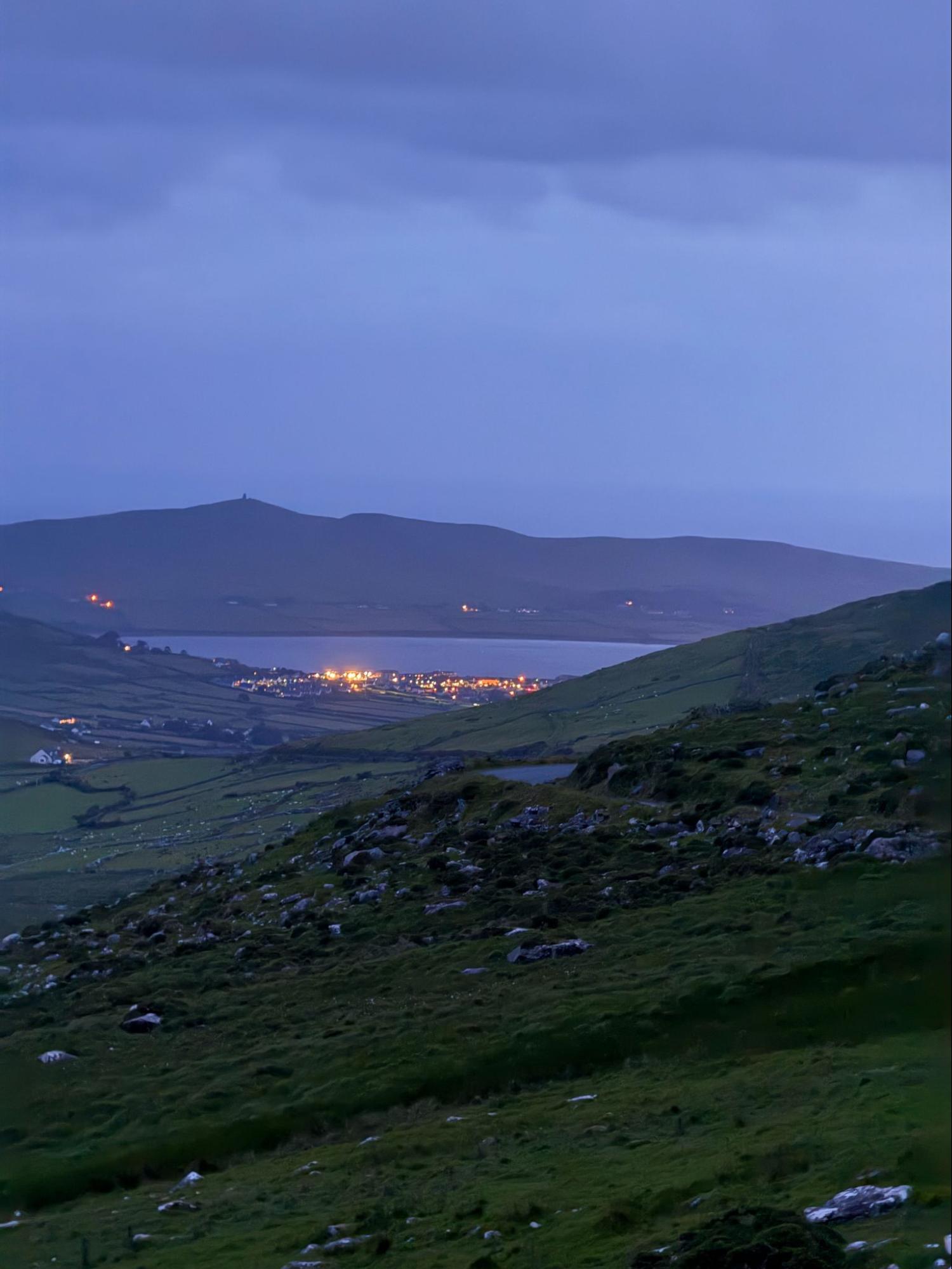
As the fog rolled in and out each day, I fell in love with Dingle. I hiked up mountains and through sheep pastures delineated by millennia-old stone walls. I found cashels, cairns, and fairy forts. I drank whiskey and Guinness. I danced, listened to live music, and sang in pubs. I fell into a bog, and got lost in the rain. After a couple of weeks, I was in love with my new home, but this isn’t a love letter to Dingle. This is about coming home.
That Which I Brought With Me
I’d like to think Jewish ritual protected me while I was away. There were things I could bring with me easily; I could say Shema before bed. I could continue to be a vegetarian, and by extension, keep a sort of kosher. When a young man sang “The Parting Glass,” in honor of his late friend Daveed, I could say, “May his memory be a blessing.” My father sent me with money specifically to donate (an old Ashkenazi custom meant to protect travelers). I donated it to An Diseart, the organization that hosted our classes and preserves Dingle’s now-uninhabited convent. I could look for three stars on Friday nights, listen to Safam’s “Just another foreigner,” and imagine two ministering angels guiding me into Shabbat. When our class went up to the famine graveyard, I picked up a stone from the gravel path to leave and I recited the last stanza of the Mourner’s Kaddish.
There were also things I couldn’t do. I didn’t even bother to look for Manischewitz or Challah for Shabbat. Even as we drove into Galway, a city of 100,000, I could not find a place to have Shabbat, not a synagogue, not a chavurah, not a Chabad house. I kept my Jewishness to myself, alive in my own heart. I stopped using Yiddishisms outside the house. I toasted, “Slainte!” instead of “L’chaim!”
Slainte!
I went to Nelligan’s Pub most Monday and Friday nights because they host set dancing. Local regulars dance with tourists, teaching them at a breakneck pace as an accordion and fiddle fill the packed house. Having narrowly survived a set with the help of a young woman named Rebecca, I headed to the bar for a drink. My friend Randy and I got locally brewed IPAs and struck up a conversation with Doug. His Belfast accent immediately set him apart from the locals. We bombarded him with questions. He proudly informed us that he’d voted for Brexit and stood by it. He loved “the Don,” Trump, and was visibly disappointed that these two young Americans didn’t. He was proudly Ulster-Protestant, an Orangeman; he started scrolling through his phone to prove this to us, passing a bunch of Swastika banners on his way. Randy and I looked at each other shocked and concerned. Doug showed us a video of himself in a parade, surrounded by other men in orange polo shirts playing music. Then Doug spotted someone wearing a keffiyeh, which clearly set him off.

“I’m an MI5 agent… I shouldn’t have told you that, but the fact remains, I’ve seen things you’ll never see, terrible things, that Hamas did on October 7th. Things that’ll never be seen by the public.”
He scrolled back to the photos of the swastikas.
“I was just in Germany. These photos are from Schindler’s factory. And here, these are the gates of Auschwitz. Here, a pile of shoes that once belonged to the Jews.”
Both Randy and I felt compelled to tell him that we are both Ashkenazi. That this happened to our ancestors. We knew. He did not need to tell us. But he kept talking. On and on about dead Jews. He “cared” so much about these dead innocents that he could excuse the deaths of others.
“Look here, these are the steps up to the gas chambers at Auschwitz. You can see the steps were deformed by the thousands of feet of the Jews that passed into them.”
He bought us both a drink. We tried to talk him down. I tried to use my Judaism, the novelty of it, to soften some of his edges to remind him that Palestinians were also suffering. I think Randy and I just came off young and naive. He came off old and callous. He excused himself for a smoke.
After six weeks, my fellow students left, and my mom arrived. A highlight of her time in Dingle was watching the All-Ireland Gaelic football championship. A young man from Dingle was representing County Kerry, and we watched the game from his father’s pub. Even better, Kerry won! A few hours later, we bumped into some guys we’d watched the game with, and we all ducked into Foxy John’s for a drink. Their names were Collum and Colin, Irishmen but not locals; they were in Dingle for a lads’ weekend. They bought us round after round of drinks and we swapped stories. My mom was not as careful as I was about who got to know that I am Jewish. She let something slip about my sister’s upcoming bat mitzvah, and the cat was out of the bag.
“You’re Jews?” Collum asked.
Cue our family’s well-rehearsed spiel about my mom not being Jewish but being on-board with raising Jews because it was important to my father. No, she never converted. No, that doesn’t matter.
“Are you proud to be Jewish?”
“Yes,” I responded, emphatic.
“How can you be proud to be a Jew?”
They’d bought us a lot of drinks, and we were all well-past tipsy. My mom and I reeled for a moment, shocked at the question, and both started to answer.
“How can you be proud to be Catholic?” I shouted over my mom. A comparison I would only make while drunk.
“I’m not.” Collum said, “But what the Jews are doing-”
“Yes! Yes, I agree – a long parade of war crimes and crimes against humanity. But can I ask you one thing? It’s what Israel is doing, not the Jews.”
He didn’t really understood the distinction. Both Dave and Collum only really knew of Jews as victims of the Shoah and as the architects of the horrors perpetrated in Gaza. Neither of them imagined that most of my life, all of my favorite parts of my life as a Jew, exists outside of those things.
Two Ministering Angels, Two Scrolls, and Two Congregations
On the Shabbat before we flew out of Dublin my mother and I went to services at the Dublin Jewish Progressive Congregation. As we sang Shalom Aleichem the two ministering angels who had descended alone to usher me into Shabbat finally had company. I was not alone as a Jew there was a whole synagogue full of us. DJPC is one of only two synagogues in the Republic of Ireland. It reminded me very much of my own synagogue’s Rinder Chapel, the smallest of our three sanctuaries. DJPC’s sanctuary has elegant stained glass work, a small bimah, and a simple wooden ark. Within both DJPC’s ark and the ark in the Rinder chapel is a Czech memorial scroll.
The Czech memorial scrolls were saved in 1964 when the purchase of 1,564 Sifrei Torah was organized by British Jews. The many Congregations of Jews who had once chanted from and worshipped with these scrolls were murdered in the Shoah, and their Sifrei Torah had been preserved so that the Nazis could later study them. The Communist Czech government discovered them decades later moldering in a basement. Those scrolls that were in irreparably poor condition were kept as a memorial, and the rest were restored and permanently lent to congregations around the world. In Hebrew school, one Simchat Torah, my class had the honor of re-rolling our Czech memorial scroll, #221, which once belonged to a congregation in Moravská Ostrava. DJPC has scroll #373, which once belonged to a congregation in Brandys. A kind, elderly man took me up to the ark and undressed the scroll for me to see. It is lighter and smaller than most Torah scrolls, and it is written in a remarkably easy-to-read hand.
The similarities between the two congregations stop there. DJPC’s security is much tighter. My mom had reached out to Hilary, one of their lay leaders, a few weeks ahead, so that we‘d be allowed in. One of our Rabbis had to vouch for us, and they checked our IDs. DJPC doesn’t have any clergy; so one of the community’s lay leaders stood at the bimah and led the service.
Hilary and her husband drove us back to our hotel. Sitting in the backseat with Hilary I learned a lot. Their parents were among DJPC’s founders. Today, she and her husband are just about the only thing keeping the place alive. She felt betrayed by her nation, because she had seen so little sympathy for the Jewish people after October 7th, especially compared to the tremendous sympathy shown to the Palestinian people. She also felt betrayed by Israeli-Irish immigrants who had moved to Dublin en masse to take-up jobs in tech but who did not go to synagogue. I’m sure that Emau-el’s memorial scroll will be with us for decades to come. I’m not sure about DJPC’s.
Return Again
As I walked onto the plane home, I started humming Irving Berlin’s “God Bless America.” The first thing I did when I got to Washington, DC, was go to the National Archives to see the Declaration of Independence, the Constitution, and the Bill of Rights. I sent pictures to my grandfather. He’s the one who convinced me America was worth loving. An American history professor, he is under no illusions about this country’s flaws; he is still a patriot. After checking into my hotel for JStreetU’s Student Leadership Summit, I walked down to the White House. As I walked past, a Secret Service member firmly shook a Marine’s hand and thanked him for his service and I couldn’t help but chuckle to myself. I walked from the Washington Monument, past the WWII Memorial, down the reflecting pool to the Lincoln Memorial. I looked out at the Capitol dome beyond the Washington Monument as the sun set and felt that each stone that made up each monument belonged to me. They do. At JStreetU, I felt even more at home, more at home than I feel in most places. We had Shabbat together. I felt neither too Jewish nor not Jewish enough. I finally felt as though I could speak freely about Israel, not only unafraid to speak my mind but unafraid to misspeak. After being so self-conscious about my Jewishness and so tied to the reputation of Israel for so long, being in that community for three days was deeply healing. I felt so proud to be Jewish.

It wasn’t until I was with my sister, in our synagogue in Northern California in America, that I felt truly at home again. On Kol Nidre, we arrived late and my sister and I had to sit apart from our parents. That little bit of separation made it feel like it was just us, just she and I carrying on the ritual for ourselves. We wept together, held each other, and prayed together. For a moment, I was simply Jewish, just immersed in the ritual, but the sermon we heard that night was about Israel. On the morning of my sister’s Bat Mitzvah, I was so proud. My father handed her the Torah, and I started crying. I barely stopped the whole service. I was so proud of her. At the same time, I thought about all the gentiles who were there to celebrate with us, and I worried that they would see the Israeli flag on the bimah and they too would think that that is all we are.



Leave a Reply