By Mia Gold
Published in the Spring 2026 issue of Leviathan
My Eyewitness Account of The Displacement of Ras al Ein
In the winter of 2025, I spent three weeks going in and out of the West Bank to engage in ‘protective presence,’ a kind of on-the-ground activism where international and Israeli citizens live in Palestinian villages and use their bodies as a barrier between the Palestinians residents and violent Israeli settlers. I spent the weekend of December 26th in the Bedouin village of Ras al Ein in the Jordan Valley [see figure 1], the largest shepherding community in the West Bank, which had been subjected to ongoing heavy settler violence. I joined activists from three different organizations, and we slept in a compound a few minutes’ walk away from the village [see figure 2], on call to join them at any moment at the sight of settlers. In the early morning of Saturday, December 27th, we got a call that a settler had trespassed onto Palestinian property with his flock and was harassing the residents. Activists responded to the call and began recording the settler upon arrival. In the past, settlers often left at the sight of the phone, in fear of their illegal activity being exposed to the world. Today, after countless videos of settlers’ violence have been released to the public, with little to no consequences for those featured in the recordings, they mock us by recording us back. Police came, chatted with the settler, and left.
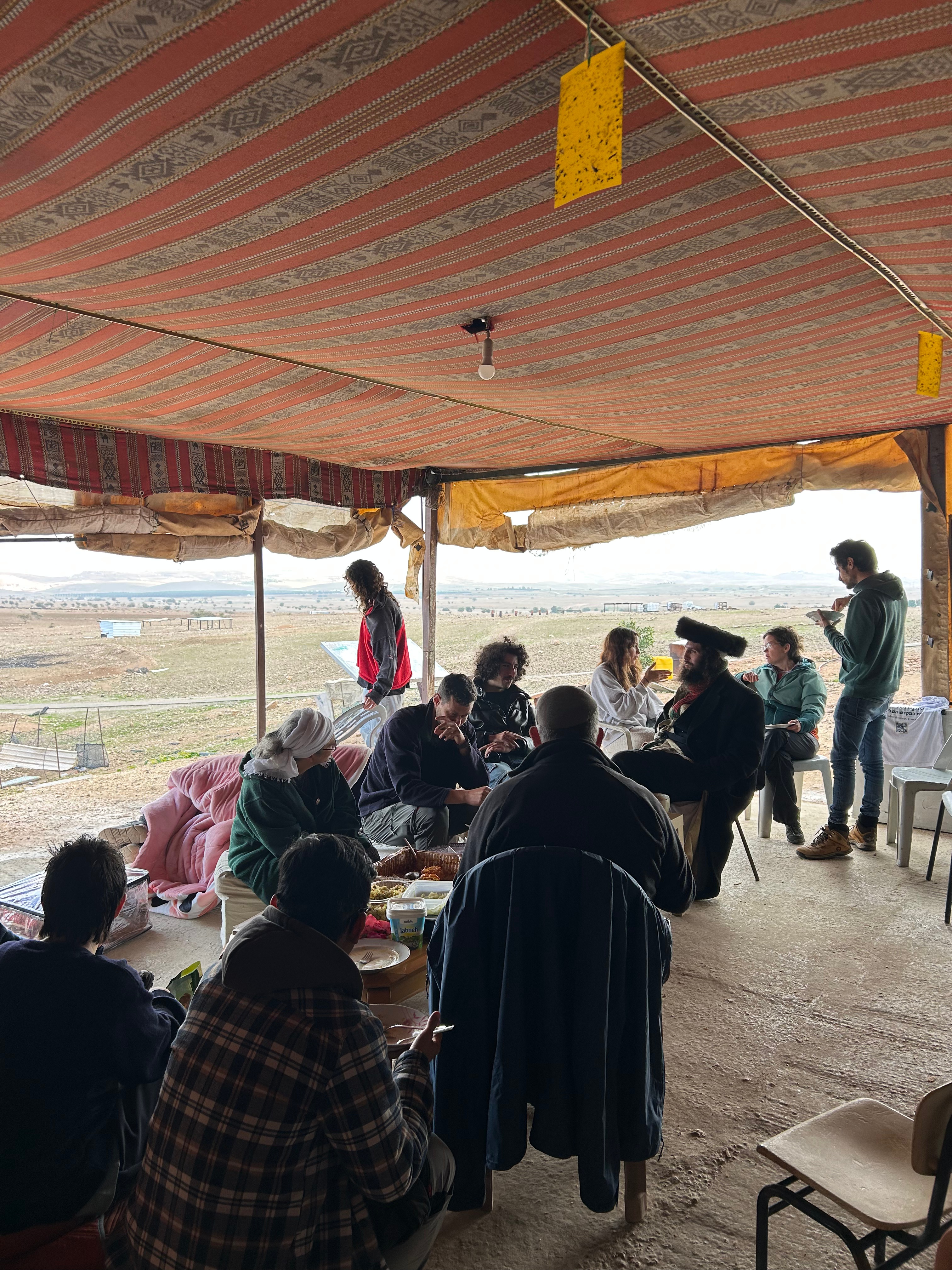
Activist compound in Ras al Ein. Activists include international citizens, ex-settlers, a haredi man, and kibbutzniks. Shot by Mia Gold.
Around noon, we got another call. A few activists went down to observe a few settlers. After an hour, more settlers arrived, and more activists joined. After another hour, more settlers arrived, and more activists joined. We stood and recorded the settlers for over four hours. Settlers called their own pseudo-army, and a man arrived with a large gun and joined them in harassing us. A child no older than 15 punched an activist and spat in the faces of multiple others. They shoved us and groped at least one activist. The police were called three times (at the request of the locals) to no avail. When the police finally did show up, they had a cigarette with the settlers and then left. The settlers left around 4 pm, only when they noticed their own flock of goats had left while they were busy harassing the Palestinian’s animals. Behind us, children from the village played soccer throughout the ordeal.
Three days later, Settlers set up an outpost in the village. Life in Ras Al Ein went from difficult to impossible. Settlers destroyed the main road and cut the electricity cables. They prevented children from going to school and water from reaching the village. They gathered outside of families’ homes at night, keeping residents awake and terrifying the children.

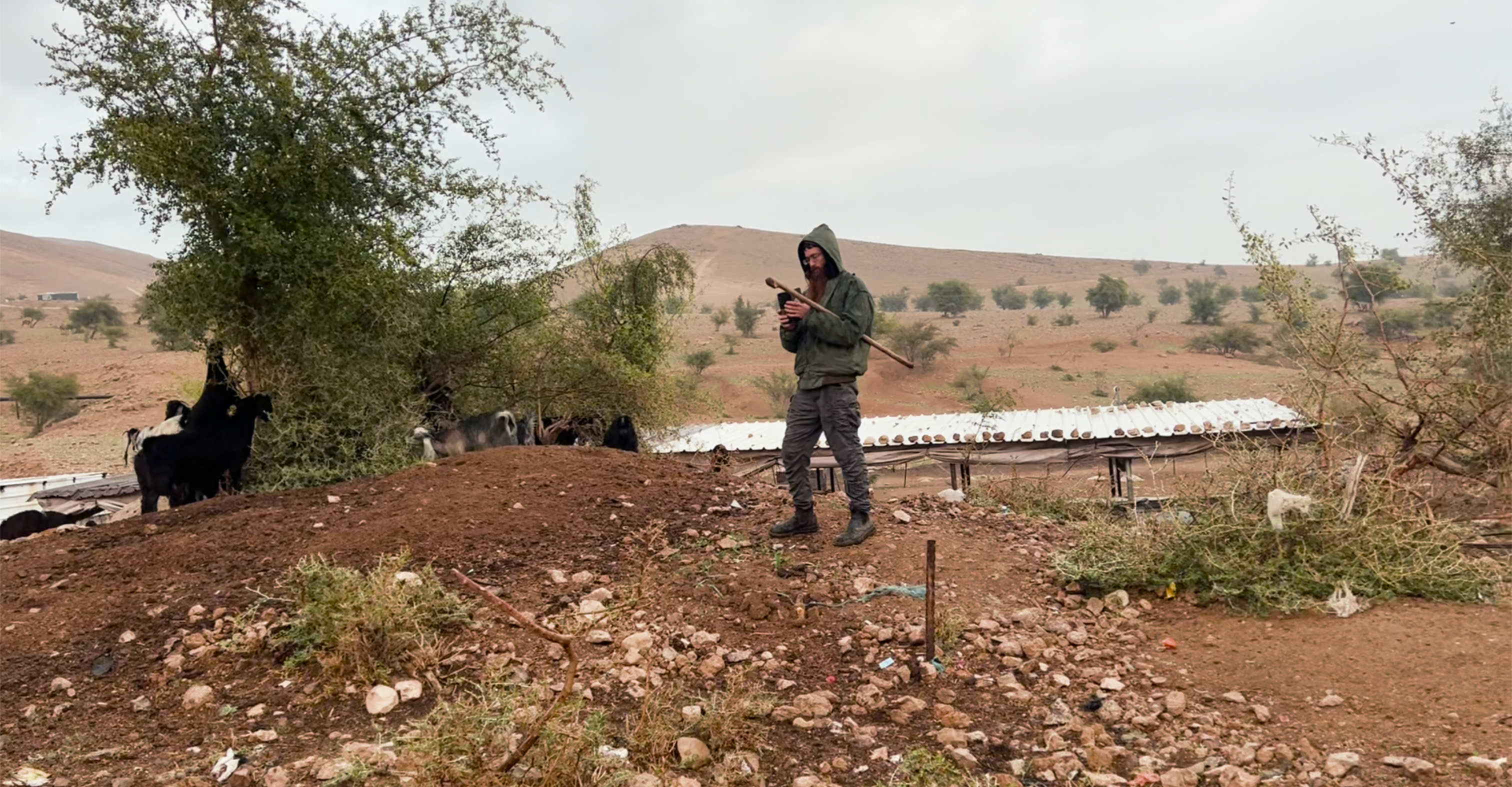
Settler and activist record each other in Ras al Ein. Shot by Mia Gold.
I remember hoping to return to Ras al Ein. As an activist, if needed, but in the best-case scenario, next time my presence wouldn’t need to be protective; I would come as a friend. I don’t need to be present in Ras al Ein anymore. There’s no one left to be present for.
As of January 24th, 2026, Ras al Ein no longer exists. All of its 800 residents were violently displaced.
For Passover, the Jewish holiday celebrating the Israelites’ freedom from slavery in Egypt, settlers partied by the stream that once served as a water source for the residents of Ras al Ein. They set up a waterslide and a barbecue, and erected flags with an image of the Third Temple. “Do you know thanks to whom this wonderful thing happened?” one man announced in a video from the celebration. “Thanks to a few youth – 16 years old! That are going around this area with their flocks. I saw them stubbornly redeeming the land for us.”
Haitham, who was among those recently displaced from Ras al Ein, responded to the video. He said, “It’s not just one incident. It’s all systematic. It’s tied to the expansion of annexation in the West Bank.”
Ras al Ein’s story is not unique.
According to a humanitarian situation report published by the United Nations’ Office for the Coordination of Humanitarian Affairs (OCHA) this April, in the first three months of 2026, 1,727 Palestinians from 36 communities in the West Bank were displaced as a result of settler violence and access restrictions.
What is Protective Presence?
These attacks are recorded and shared with the public by international activists on social media and spread through news sources. Activists also show videos of the illegal actions of settlers to the Israeli police, who usually take no action. Even with a constant activist presence in Ras al Ein and video proof of the violent, illegal settler activity, Ras al Ein’s residents were still displaced.
Despite the recent objective failures of international presence in actually preventing violence and displacement, the most common answer to “how can we help?” from West Bank Palestinians in my time there was: “Come to Palestine.”
By engaging in protective presence, international activists are playing a role in the Palestinian-led struggle against displacement in the West Bank today. Activists stay anywhere from half a day to months on end in Palestinian communities, usually in Area C [see figure 1]. Activists engaged in protective presence respond to calls from Palestinians requesting our presence. Activists are present when settler violence occurs to record and try to de-escalate. Activists usually stay at a family’s home in communities that are regularly targeted by settler violence. Activists may also accompany children to school, help out during the olive harvest, and play games and make art with the children. One of the most important parts of this experience is that activists take these stories home with them and share them with their friends, family, and public media. Eyewitness accounts are incredibly important.
But what we call “protective presence” is clearly failing to protect Palestinians from violence and displacement.
Protective Presence Doesn’t Work Anymore
Activist and journalist in Palestine, Andrey Khrzhanovskiy, wrote a piece for Vashti Media titled “Protective presence isn’t working anymore.” The presence of Israeli and international citizens is supposed to be able to protect Palestinians from settler and state violence, at least to some degree. Protective presence has had many successes in the past. In 2002, residents of Yanun were actually able to return to their village after initial displacement with the help of activists. Andrey describes an incident in June 2024, where settlers refrained from attacking Palestinians in Ras al Ein when Andrey and other activists accompanied them. An international civilian presence used to provide protection, but “that was a different time,” Andrey says.
A year after activists were able to deter settler violence in Ras al Ein, on July 28, 2025, Awdah Hathaleen, a Palestinian nonviolent activist, was murdered in Massafer Yatta [see figure 1] by Yinon Levi (a settler who was sanctioned by the US until Trump’s January 2025 decision to repeal all sanctions on settlers in the West Bank) “in front of a dozen international and Israeli activists filming from every direction.” Levi faces no consequences. “They no longer care that we are there,” Andrey writes. Somewhere in the past year, “the settlers stopped flinching at the sight of a phone.”
This new reality leaves many people asking: How did we get here, and what do we do now? To understand the escalating and unpunished settler violence in the West Bank, one must have basic knowledge of the way the occupation functions, and how it serves to privilege Jews, punish Palestinians, and promote violence.
Occupation: How It Works
The apartheid system present in the West Bank places Palestinians under a different system of law than all other people. International and Israeli citizens are subjected to Israeli civil law, while Palestinians are subjected to Israeli military law.
Israeli citizens in the West Bank can vote in Israeli elections from the occupied territories, the only exception to Israel’s law that citizens must vote inside the country. Israeli settlers living in the West Bank can vote for representatives and on policies that have control over elements of their lives. Palestinians, however, who reside in the same territory and are subjected to the control of the same government, cannot vote and have no influence on the policies that shape their lives.

Israeli flag and large Menorah for Chanukah put up by settlers on the fence of a Palestinian village. Shot by Mia Gold.
A. Military Law:
Military law is not really a set of laws—it’s a series of military orders, supposedly impermanent, that legally categorize Palestinian residents of the West Bank as a constant, imminent threat, and allows the state to treat them as such. These orders are issued by the Israeli military commander, who has legislative, judicial, and executive control over the Occupied Territories. According to B’tselem, this allows Israel to “control the occupied Palestinian territory through the criminalization and punishment of all forms of Palestinian resistance to the Israeli occupation, regardless of its gravity and violent or non-violent nature.” Military orders allow the army to shut down non-violent demonstrations in the West Bank. Freedom of speech is considered a basic right under international human rights law. But, under military occupation, the occupying force can restrict freedom of expression when it deems those expressions a safety risk. For Palestinians, an “incitement offense” can be given after “any incident in which a person attempts to influence public opinion in a manner that could harm public safety or public order.” This ambiguously worded offense is penalized with ten years of imprisonment, and has been used “by the military courts to adjudicate Palestinians in offenses that concern…hanging posters or writing slogans against the occupation.” However, under Israeli law, an incitement offense can only be given in relation to “incidents in which a person published something intended to incite to violence or terrorism, and under the condition that there is a concrete possibility that this publication will lead to the committing of the act of violence or terrorism.” For Israelis who commit this offense, the prison sentence is 5 years.
Palestinians in the West Bank have functionally no freedom of expression; even weddings and funerals can be defined as illegal assemblies, which allows the military to respond to these gatherings with force, often using violence and sometimes resulting in deaths. The funeral of Awdah Hathaleen was stopped by the Israeli military when they declared the area a closed military zone and ordered all activists, journalists, and mourners who did not live in the area to leave. When asked why the area had been closed, the military did not reply.
Military orders are used to silence Palestinian voices, limit freedom of movement, and aid settlers in their efforts to displace Palestinian villages, which can be demonstrated clearly in the military’s use of closed military zone orders.
B. Closed Military Zone Orders:
One of many military orders used by the Israeli military to aid settlers in displacing Palestinians villages is a closed military zone order, also sometimes called a firing zone. Once an area is declared closed, everyone who is not a resident is required to leave. On paper, “a military commander will declare a closed military zone when security needs or the need to maintain public order require the closing of the area.” In practice, these orders are regularly used to remove activists from villages targeted by settler violence. After activists are gone, Israeli settlers often enter (in some cases, settlers are already present and trespassing at the time activists are removed) and raid the area; stealing, damaging property, and attacking Palestinians are not uncommon occurrences.
On May 3rd, 2026, the settlers responsible for the displacement of the residents of Ras Al Ein, including Neriya Ben Pazi and Avishai Horowitz, set up an outpost 5 meters away from the village of Taybeh, in East Ramallah. On-the-ground activists and journalists Andrey Khrzhanovskiy and Adele Shoko posted videos of their interactions with settlers and the army to Instagram. When activists called the police, the police came, shook hands with the settlers, and left. The army returned at night after the settlers began throwing stones at the activists. The army then declared the area a closed military zone and removed activists. Settlers lingered behind. Activists left and slept in the car a short drive away, ready to return if called upon.
C. Military Court and Remand in Custody:
Since 1967, when the occupation began, military courts have been operating in the West Bank. In the early 1980s, “the Attorney General decided that Israeli citizens would be tried in the Israeli civilian court system according to Israeli penal laws.” Meaning that Israeli settlers who live in or commit crimes in the Occupied Territories are tried in civilian courts under civilian law, and Palestinians who reside in the same place are tried in military courts under military law.
Palestinians tried in military court are usually remanded in custody until the end of court proceedings, something not allowed in Israeli civil court. Without trial and without sentencing, these individuals are kept in custody until proceedings are over. The prosecution can ask for remand in custody, and almost always these requests are granted. In order to issue a remand in custody, the prosecution is supposed to “prove the presence of all three conditions…evidence to prove guilt, grounds for arrest, and lack of a relevant alternative to detention which could achieve the purpose of detention in a manner that is less injurious to the defendant.” But military judges interpret these conditions, and the evidence, as they please, “[rendering] them meaningless and [nullifying] their effectiveness.” Often, the time the defendant is held in remand is longer than the sentence they would receive for a plea bargain. As a direct outcome of this policy, the vast majority of Palestinians take a plea bargain to avoid an extremely lengthy trial. “The prosecution is seldom required to go through a full evidentiary trial in which it must present evidence to prove a person guilty,” B’Tselem said in a 2026 report on the military courts. “Instead, the outcome of the case is decided at the time remand is granted, rather than on the basis of evidence against the defendant.”
This all demonstrates how the Israeli military and settlers are part of the same system of control that seeks to achieve the displacement and domination of the Palestinian people. This system privileges Israelis and international citizens, leading activists to take advantage of their privilege to record settler violence and to stand between settlers and Palestinians in an attempt to deter violence.
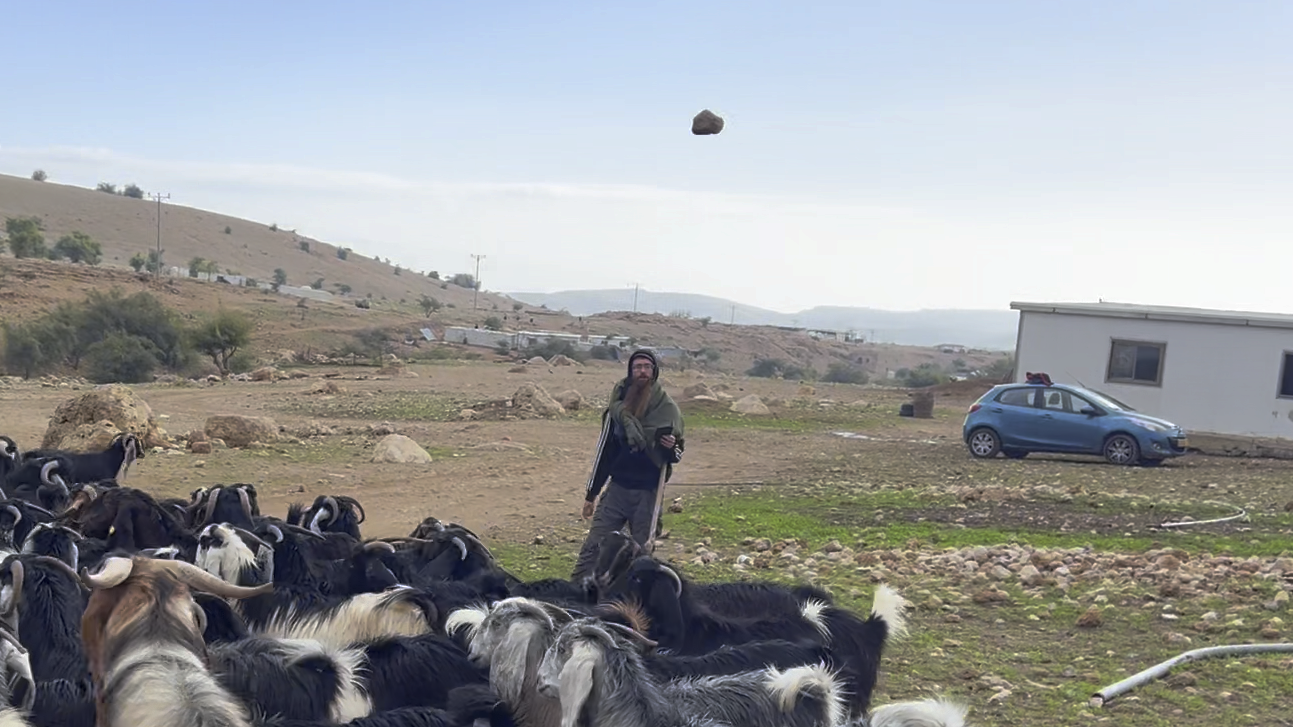
A settler in Ras al Ein throws a rock at an activist. Shot by Noah Grose.
Why do we still show up?
While there is still deep systemic racism in Israeli policy, on paper, Israel categorizes the violent actions of settlers—trespassing, harassing, attacking, and killing—as illegal. On paper, in Israeli law, you cannot kill Palestinians, steal their land, and get away with it unpunished. Although Israel’s legal system discriminates against Palestinians, on paper, it doesn’t legalize the settlers’ violence. According to their own laws, on paper, the police should respond to calls of settler violence and arrest perpetrators, and then the court systems, on paper, should punish them.
The legal system discriminates, but the occupation we see on paper still does not capture the extent of the violence that occurs. Israel has control over the region and makes decisions as it pleases that benefit itself as a state and its citizens, who are complicit in its ethnic cleansing project.
Because of our legal protections, settlers used to leave solidarity activists alone. But in the past year, settlers have begun attacking activists too, even while cameras roll. Settlers have realized they can get away with this violence, too, as Israel abandons not only Palestinians but Israeli citizens, too. Israel will not protect even its own citizens if they do not protect the state’s ethnic cleansing project.
“The question we ask ourselves over and over is what can we do in this new reality?” Andrey writes for Vashi Media. “What difference can we make when we’re no longer recognised as a barrier to violence, but just another target?” Andrey proposes two things. The first is record-keeping. Continuing to document the ethnic cleansing in Palestine may one day lead to “a faint sense of justice” if “perhaps one day there will be Nuremberg trials of the Israeli occupation.” Given that evidence collected by activists has been used to enact sanctions in the International Court of Justice, perhaps there is some value in these recordings.
But Andrey offers an answer for his continued presence, despite how much protection it can ever provide: solidarity. “We can’t offer protection anymore,” Andrey writes. “The residents of Palestinian communities want us to be there nevertheless…We don’t know whether liberation will ever come, but we need to fight for it anyway.”
Even as the ethnic cleansing has only sped up in recent months in the West Bank, and efforts of activists are increasingly less effective, activists aren’t retreating from the work they are being called on by Palestinians to do. “Even if all our efforts are doomed,” Andrey writes, “we will continue to be there for our friends, for as long as we physically can.”
We aren’t just present for our friends to protect them. We are present because they want us to be. And we want to be present for them too.

A child outside of where we ate dinner in Farsiya, Jordan Valley. Shot by Mia Gold.
A Letter From Hana
I will conclude with a letter written by Hana, my friend and incredible poet, to my cohort after our stay in Farsia. Hanna expresses the deep love these relationships build, and her gratitude for our presence, even if that presence could not protect:
“Welcome to all hearts that arrive before names, and to all souls that traverse distances without carrying their maps. I don’t see homelands as borders drawn on paper, but as living faces, as friends whose features are shaped by different places, yet whose hearts meet at one point: humanity. Here, we gather from the North, where snow teaches patience, from the South, where the sun knows the meaning of warmth, from the East, which dreams despite everything, and from the West, where the horizon expands as the soul expands. We don’t speak the same language, we don’t share the same skin color, and our cultures are not alike, but we resemble the world when it becomes more compassionate. We laugh in different languages, and hearts understand us before ears do. We cry with diverse experiences, and tears unite without the need for translation. Among us are friends from the East, from Africa, from Europe, from the Gulf, from distant lands, and from cities that know the sea well. We meet like a caravan of peace, carrying nothing but hearts that know that true belonging lies in what unites us, not in what divides us. With them, I now understand that home is not a place, but a hand reaching out to you when you’re weary, a voice that reassures you even across distances, and a soul that, when you sit near it, makes you feel you’ve arrived, no matter how far you’ve gone. We come from rain and sand, from cold and heat, from every direction, but our hearts meet at a single point, as if the world is being redrawn in the shape of friendship.”

A woman carries a basket in Farsiya. Shot by Noah Grose.


Leave a Reply